
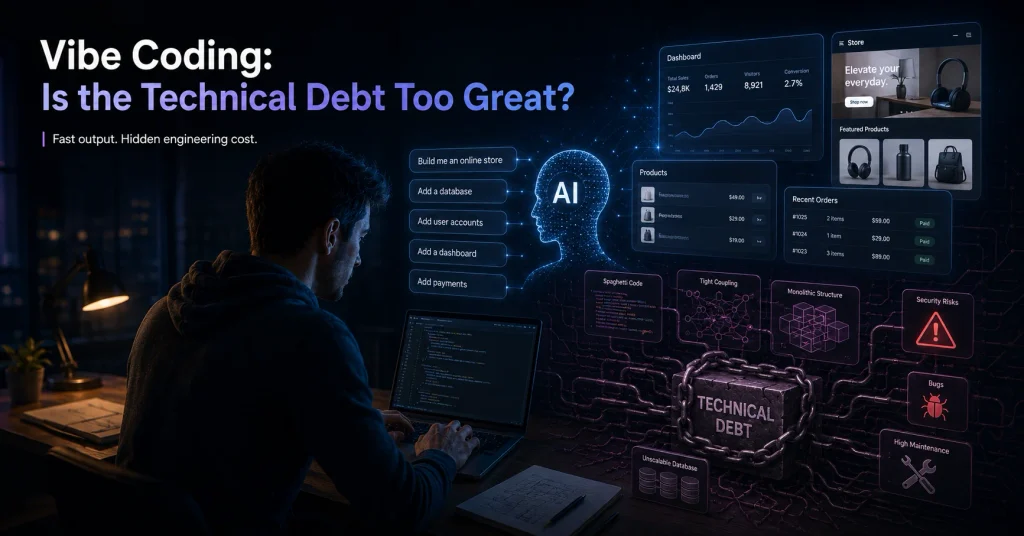
Artificial intelligence has changed software development faster than anyone expected.
Today, someone with little or no traditional programming experience can describe an application in plain English, have an AI tool generate the code, test parts of it, make changes and potentially end up with a working application in a fraction of the time that traditional development would have taken.
This is commonly referred to as “vibe coding.”
The term became popular after AI researcher Andrej Karpathy described a style of programming where the developer relies heavily on AI-generated code and directs the development process through natural-language instructions rather than manually writing every line of code.
But there is an important distinction that often gets lost in the hype:
Vibe coding can produce software. That does not automatically mean The engineering is good.
So, what actually is vibe coding, how does it compare with traditional development, and should you trust someone to build your business-critical application this way?
What is vibe coding?
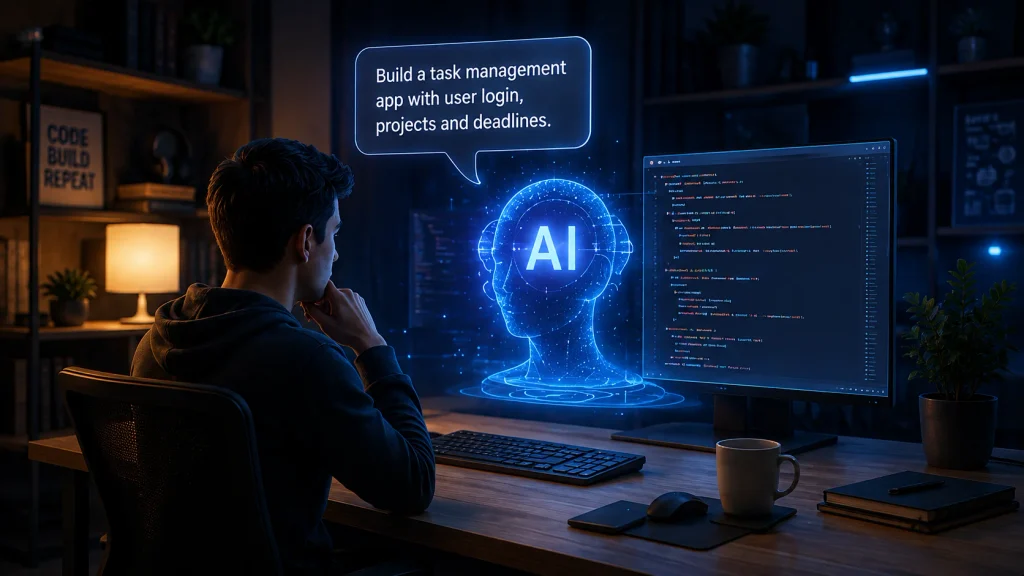
Vibe coding is essentially building software by describing what you want to an AI system and allowing it to generate much of the underlying code.
Practically, instead of manually writing:
function calculateTotal(items) {
    ...
}
a person might simply tell an AI:
“Build a shopping cart that calculates the total price, applies discounts and shows the customer the final amount.”
The AI can then generate the code required to implement the feature.
The person can continue prompting:
“Add a delivery fee.”
“Make the checkout mobile-friendly.”
“Allow customers to remove products.”
“The total is calculating incorrectly. Fix it.”
This can create a very different development experience from traditional programming.
The person building the application may spend significantly more time describing requirements, reviewing output, testing and correcting the system than manually writing code.
That does not mean there is no coding involved. There is usually a considerable amount of code development. The difference is that the human may not personally write most of it.
And this is where the term “vibe coding” can become misleading.
A professional developer using AI to generate code has many benefits in comparison with traditional coding. The difference in engineering the deliverable comes down to the technical knowledge of the person using the AI. Someone who has little understanding of the underlying system and coding in general and simply keeps prompting until something appears to work will face many troubles.
Those are two very different approaches.
How is vibe coding different from traditional coding?
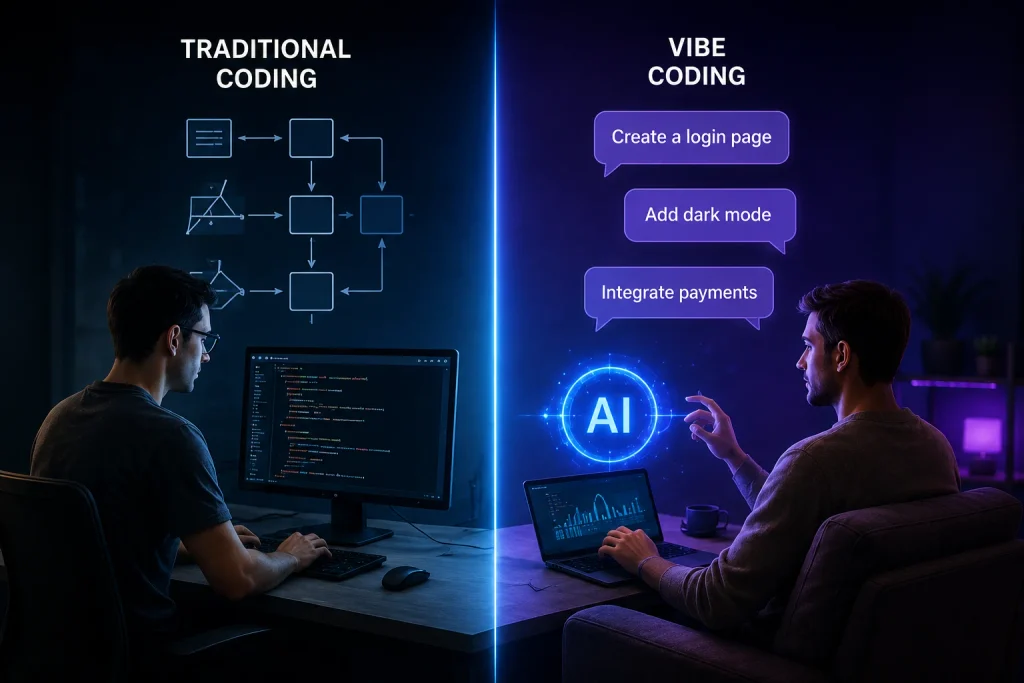
Traditional software development generally follows a structured engineering process.
A developer or development team will typically start by understanding the requirements, designing the architecture, choosing technologies, creating the database structure, writing code, testing the application, reviewing the code and eventually deploying and maintaining it.
AI-assisted development changes the economics and speed of many of those steps.
A software developer can now ask AI to generate boilerplate code, create database queries, write tests, explain unfamiliar code, identify bugs, create API endpoints or even make substantial changes across a project.
Vibe coding takes this a step further.
Rather than the human being primarily responsible for writing the implementation, the human becomes more of an orchestrator of the AI.
This can be incredibly fast. However, speed is not the same as engineering quality.
One of the clearest indicators of this is the growing use of AI among professional developers. Stack Overflow’s 2025 Developer Survey found that 84% of respondents were using or planning to use AI tools in their development process, while 51% of professional developers said they use AI tools daily. At the same time, 46% of developers said they distrust the accuracy of AI output, compared with only 33% who said they trust it.
In other words:
Professional developers are using AI heavily — but many still do not blindly trust what it produces.
Traditional coding asks:
“How should we build this system?”
Vibe coding tends to ask:
“Can AI build this system for us?”
Modern professional development increasingly sits somewhere in the middle:
“How can we use AI to build this system faster while still applying proper software engineering?”
Would you be comfortable handing your entire project to a vibe coder?

This is probably the most important question with regards to vibe coding. It entirely depends on what you are building and who is doing the work.
Imagine you need a small internal tool that takes information from an Excel spreadsheet and turns it into a report. The consequences of a mistake may be relatively small.
Now imagine the project is:
- A payment platform
- A medical application
- An accounting system
- An e-commerce platform
- A customer database
- A system handling sensitive information
- A large enterprise application
- An application expected to operate reliably for years
The standard changes completely, thus the issue is not whether AI can generate the code.
It absolutely can.
The issue is whether the person responsible for the project understands what the generated code is doing and can take responsibility for the finished system.
This includes questions such as:
- Who designed the architecture?
- Who understands the database?
- Who handles authentication and permissions?
- Who knows where sensitive information is stored?
- Who can identify security vulnerabilities?
- Who can diagnose a production outage?
- Who can maintain the application six months from now?
- Who can take over the project if the original developer disappears?
A person who can generate an impressive prototype with AI is not necessarily capable of engineering a reliable production system.
There is a growing reason to take this seriously. In the 2025 Stack Overflow survey, 66% of developers said their biggest frustration with AI tools was receiving solutions that were “almost right, but not quite,” while 45% said debugging AI-generated code can be more time-consuming.
That is the hidden cost of vibe coding.
The first 80% can be extremely fast.
The final 20% can involve architecture, edge cases, security, testing and debugging — exactly the areas where experience matters most.
What should you expect as deliverables?
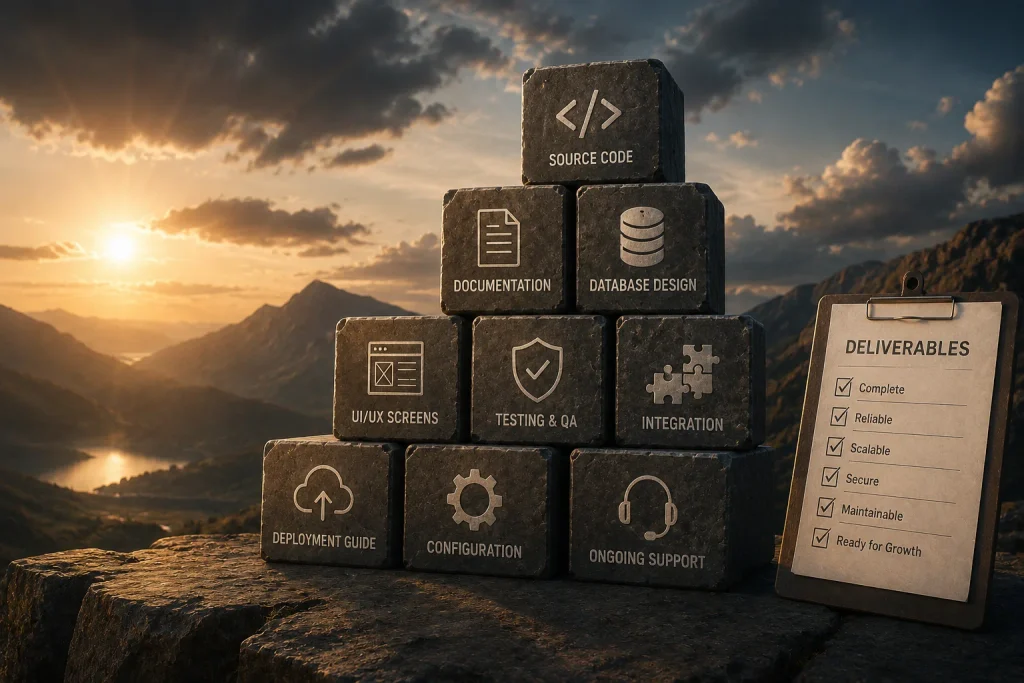
Whether AI was used to develop the software should not determine what you receive as the client.
You should still expect a proper software project. At minimum, a professional software development engagement should result in clearly defined deliverables.
Source code
You should receive the complete source code for the application, not merely access to a hosted website. Ideally, the developer should stored the code in a version-controlled repository such as Git.
Database structure
If the application uses a database, you should know what database technology is used and receive the relevant schema, migrations and configuration.
Documentation
You should receive enough documentation for another competent developer to understand how the application works and how to run it.
Testing
There should be evidence that the application has actually been tested.
Depending on the project, this may include automated tests, integration tests, security checks, user acceptance testing and manual testing.
Deployment information
You should know how the developer is deploying the application, where it is hosted and what infrastructure it depends on.
Credentials and ownership
Business-critical systems should not depend entirely on one developer’s personal accounts.
Hosting, domains, repositories, APIs and other critical services should have appropriate ownership and access controls.
Support and maintenance terms
Software is rarely “finished” forever.
You should know what happens when a bug is discovered, a dependency becomes outdated, a server fails or the business needs a new feature.
These expectations do not disappear simply because the developer involved AI primarily in the development process.
In fact, they become even more important.
The biggest hidden issue of vibe coding: technical debt

Vibe coding has another potential problem that is less visible during the initial build.
It can create technical debt extremely quickly.
When someone builds software using AI to immediately solve the problem and the code-base is not kept clean, future changes become exponentially more difficult, expensive or risky and it ends up creating technical debt.
For example, an AI might generate three different solutions to three similar problems because the prompts were given at different points during development. Underneath the surface, the code-base may become inconsistent and increasingly difficult to maintain.
You might then ask AI to add another feature.
That feature works.
Then another.
And another.
Eventually, nobody fully understands how the system fits together. This is one reason professional developers still matter even when AI is doing a significant amount of the coding. A good developer is not simply producing code.
They are making decisions about architecture, maintainability, performance, security, scalability and trade-offs.
AI can assist with those decisions. It should not automatically be trusted to make all of them.
So, when does vibe coding make sense?
Vibe coding isn’t inherently bad, in fact, it can be extremely useful.
It is particularly powerful for:
Prototypes – You have an idea and want to see what it could look like before investing heavily in development.
Proofs of concept – You want to test whether a particular technical idea is viable.
Internal tools – You need a small application to solve a specific operational problem.
Automation – You want to automate repetitive tasks and integrate existing systems.
Simple applications – The application has relatively limited complexity and low security or compliance requirements.
Rapid experimentation – You want to test multiple ideas before deciding which direction to take.
It is also an excellent productivity tool for experienced developers.
The real question isn’t “Was vibe coding used?”
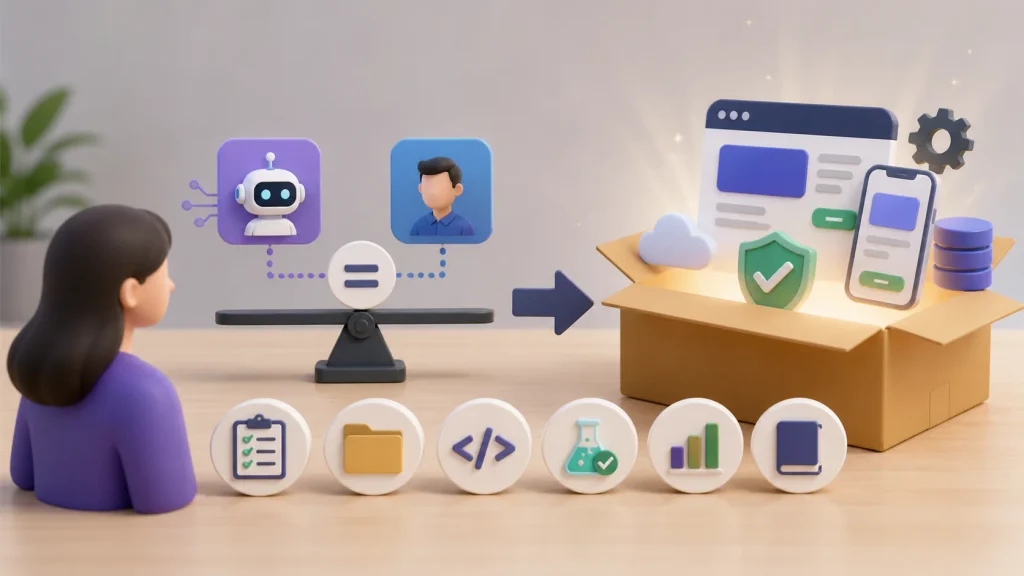
One of the biggest mistakes a business can make is judging a software project based on whether the developer built the project using AI.
The better questions are:
- Does the software work?
- Is it secure?
- Is the architecture appropriate?
- Is the code maintainable?
- Has it been tested properly?
- Can another developer take over the project?
- Do you own the software and its infrastructure?
- Can the system scale with your business?
And perhaps most importantly:
Is the person building it capable of taking responsibility for the answers to those questions?
Conclusion
AI has made software development dramatically more accessible. That is a good thing. Someone with an idea can now turn that idea into a working prototype far faster than ever before and give through their ideas much more accurately to experienced developers.
But there is a significant difference between creating software and engineering software.
Professional software engineering is what helps get you from prototype to something your business can confidently depend on.
At AUTOSCRIPTX, we believe developers should use AI as a force multiplier — not as a substitute for engineering judgment.
The future of software development is highly unlikely to be humans writing every line of code themselves.
It is much more likely to be humans directing increasingly capable AI systems while experienced developers remain responsible for the architecture, quality, security and long-term success of the software.

Leave a Reply